In the sessions of Week Three, we did a range of exercises which correlated with our mini lectures on the practitioners Brook and Grotowski who were influential in the prospect of experimental theatre. These exercises helped us grapple the concepts of these practitioners, and also gave us an insight into the routine exercises these practitioners conducted as directors.
In Monday's session, we were focusing primarily on the concepts of Jerzy Grotowski.
We discussed the idea that central to Grotowski's work, he gave the actors a 'series of shocks':

1) The shock of catching sight of his own evasions, tricks and clichés.
2) The shock of sensing something of his own vast and untapped resources.
3) The shock of being forced to question why he is an actor at all.
4) The shock of being forced to recognise that such questions do exist and that - despite long English tradition of avoiding seriousness in theatrical art - the time comes when they must be faced. And of finding that he wants to face them.
These 'shocks', in the theory of Grotowski, were central to the aim that actors could tap into their raw untapped emotion without consciousness, and this would lead to their optimum sacrifice within theatre. In 'Towards a Poor Theatre', Grotowski's book, he focused on how the stage could be stripped back to the extent where it was just the actor's body in the space involved with the audience. This involved a number of stages, which we explored through a number of exercises.


In order for the actor to reach a pure state of creativity, they need to push themselves to their physical extremes. The body needs to be pushed in order for the mind to submit, almost like being in auto pilot.
Exercise One: Following the Body
The first thing we did was find our own space in the room and we sat in a crouching position. The focus here was the breath; firstly by finding it, then breathing deeper into the bottom of our backs, building up energy through faster and deeper breaths as the body was stationary, and reaching a place where the amount of energy accumulated has created potential. When the energy became unbearable, we began to burst and move forth around the room, allowing that energy to carry us through the space without consciousness or embarrassment. The further focus here was to allow the impulses to dictate the movement. When we bumped into eachother, we stopped and created a structure for the rest of the moving individuals in the space to navigate without self consciousness.
With this exercise, initially, there was a lot of mental and physical blocks. Mentally, it was either said than done to not let your own doubts and afflictions to influence you into evaluating what you were doing, and physically, you had to really focus on using your peripheral vision to navigate the space although this was still seemed challenging given the smaller constraints of the room. Nevertheless, I would argue that there was a point in which these mental and physical blocks became less prominent: as we became more at ease within moving throughout the space with the use of peripheral vision and spatial awareness, not only did the physical blocks minimise but equally we were able to ignore any mental blocks too, and relax as an ensemble within the room. At this point, we reached a period of focus where all of us were less conscious and this was an interesting and insightful way for me to understand that similarity that Grotowski really wanted, in wanting a focused ensemble with no mental inhibitions that blocked them from reaching their raw untapped state.
Exercise Two: Passing The Energy
We stood in a circle and passed 'the energy' around the space, which took place in a circular motion. First, this was a clap and then it evolved into impulse led gestures and movements. We then repeated this with a leader in the middle of the space. That individual in the middle of the space closed their eyes and followed an impulse, evolving into a repetitive dance like movement that was then mirrored by another individual joining the circle. From this, a chain like effect was created in which every individual who went into the circle would create a movement based off an impulse.
The physical blocks I experienced when I went into the middle of the circle correlated with the mental blocks I experienced. I found myself quite relaxed and open when I had my eyes closed, but as soon as I opened my eyes I became more tense and self aware about what I was doing, but I tried to override these blocks by focusing on the breath and using this to ease and clarify the movement.
Exercise Three: Leading with an Impulse
Similarly to Exercise Two, there was a significant focus on impulses and focusing on instinctual impulse rather than preconceived impulses. We began to evolve impulses in the space with only one leader, yet the impulse/energy would still effectively get 'passed' from one person to another, allowing the impulses to evolve. We started with stamping, which became clapping, evolving naturally into things that were vocal, breath, claps, using the whole body or physicalised sound.
This was quite beautiful to be apart of, and to me it illustrated how in an ensemble where everyone is offering and committing you can actually make a piece of theatre just using voice and sound. I think that from an audience or spectator perspective this would have been interesting to watch, which accentuates Grotowski's ideas of 'stripping back the space'.
STAGE TWO: CONTRASTING CONTRARY EMOTIONS
Exercise One: Opposite Movements
We started patting our head while simultaneously rubbing our tummy, and similarly began rotating our arms in opposite directions, walking around the room slowly but with fast arms and vice versa, punching the air with one hand and stroking the hair with the other, punching the air and reacting through the face and also reacting facially (as well as with the whole body) to being stroked while punching the air.
This exercise highlighted the importance of communicating raw emotion through physicality, but also how our body be malleable in communicating multiple things even at once.
Exercise Two: Hat Stand
This exercise involved us becoming a hat stand: the body is a hat stand with many pegs. Various parts of the body become hats hung on the many pegs. This exercise was challenging because we had to focus on suspending different parts of the body, which is difficult in practicality.
Exercise Three: Voice
In this exercise we focused on finding the optimum resonance for our voices, and how as actors if we tap into our untapped emotions and subconscious our resonance and connection to what we're doing can improve. We walked around the room vocalising vowels, and explored a range of body positions on and off the floor and around the room, aiming to find a position where we felt the sound resonated the most.
My personal position where I found optimum resonance was on the floor in a semi-supine position. Physically, it made me feel comfortable and relaxed but emotionally the position made me feel very grounded and I associated it with the connotations and emotions of lying in my bed at home in that same position, which is how I think I tapped into my emotions to find resonance.
Exercise Four: Exploring Dialectics/Exercises in Composition
Within this exercise we focused on senses, and the significance of opposing forces. This involved the stimulus of walking over ice, walking over hot surfaces, walking over slippery surfaces, touching a snake/lizard and feeling a soft furry surface. We also began to explore different things simultaneously and began to perform some of these tasks where our hands and feet where experiencing the same things at the same time.
As a response to this, we then got into groups and created visual tableaus which explored contradictions. Some of these contradictions included the themes of guilt and innocence, creation and destruction, birth and death and peace and war.
We created sounds that informed these visual tableaus, where the primary focus was to eradicate emotional blocks in the voice.
We then put these into a scene where we worked dialectically. A piece of immediate theatre was created where Tyreke represented and played a positive yet lying politician to the crowd who created a contradicting energy. This scene was relevant to the vision of Grotowski through removing the masks from ourselves and translating theatre to relate to society.
Within this exercise we focused on senses, and the significance of opposing forces. This involved the stimulus of walking over ice, walking over hot surfaces, walking over slippery surfaces, touching a snake/lizard and feeling a soft furry surface. We also began to explore different things simultaneously and began to perform some of these tasks where our hands and feet where experiencing the same things at the same time.
As a response to this, we then got into groups and created visual tableaus which explored contradictions. Some of these contradictions included the themes of guilt and innocence, creation and destruction, birth and death and peace and war.
We created sounds that informed these visual tableaus, where the primary focus was to eradicate emotional blocks in the voice.
We then put these into a scene where we worked dialectically. A piece of immediate theatre was created where Tyreke represented and played a positive yet lying politician to the crowd who created a contradicting energy. This scene was relevant to the vision of Grotowski through removing the masks from ourselves and translating theatre to relate to society.
In Tuesday's session, we were focusing more so on the concepts of Peter Brook, whose ideas are largely derived from Grotowski's work too.

Peter Brook largely condemns the idea of 'The Deadly Theatre' or 'capitalist theatre', theatre that is dead, empty, monotonous and provides no transcendental experience. In his book 'The Empty Space', Brook explained why 'The Deadly Theatre' occurs in 7 steps:
 Instead, Peter Brook was fascinated with the 'holy theatre' - a new, fresh theatre that adds to the art form. He talks about the idea that theatre can happen and occur anywhere, and wanted it to be full of endless possibility where it is always changing in response to society. He was constantly determined to 'net the golden fish' and transform our thinking, and as a result he liked to create massive visual spectacles and subversive pieces of art: for example, his version of A Midsummer Night's Dream at the RSC in Stratford in the 1960s was his breakthrough performance. It involved a white, bare set with all the actors flying around the stage on swings on various levels. Through this production, he created memorable, elaborate images through using Shakespeare's text as a basis and re-imagining it in a fantastical way.
As well as this, Brook was fascinated with the idea of ritualistic theatre and wanted the experience of theatre to be almost like a ritual too. Theatre should be like a ritual in the fact that it is a communal experience, he thought, theatre can therefore cause healing and revelation. The role of theatre should be resounding affirmation in everyone's lives: people must be given a hunger for art and see that it is necessary for life.
Exercise One: Blindfolded
As actors, often we rely too much on sight to communicate within a play. In this exercise, we took the sight away through blindfolding too people within the circle and giving them the simple task to find the paper baton somewhere in the circle and hit the other person with it. As spectators in the circle, we had to be very silent so that the two participants had one less sense of hearing where they were. This exercise was very interesting to observe because as soon as the two participants were blindfolded, it was evident how imminently they became vulnerable within the space. They had to trust themselves, each other and us as an audience within the space and there was instantly a sense of ensemble feeling. As spectators we had the benefit of dramatic irony, and the pursuit of the two people in the space having to find the paper baton and then the other person was very funny and entertaining to watch, particularly when one of them would be really close to the other person who had the baton, for example. Their vulnerability and stripped down senses meant that their pursuit to carry out this task in the circle was purely instinctual and reacted based on their impulses, and when they were less concerned about how this would look and it meant that their performance within the circle was very truthful. When TJ was hit by Rrahiim with the paper baton, his reaction was so dramatically comedic and animated yet so truthful, and these moments were really interesting and funny to watch. This links to Brook's ideas because he wanted the same vulnerability that the participants possessed in this exercise to be abundant all the time, as a result creating raw, powerful and truthful reactions based on instinctual impulses. It also inhibited the idea of a conventional 'Deadly Theatre' play which often lacks the awareness of other sensory forces.
Exercise Two: Internal Emotion Reflected Through The Body
This involved a series of improvisations. The first one myself and Stash did: our task was to enter the room, face the wall, sit down and adopt a state of being almost like we were meditating. Stash entered the room first: she was incredibly neutral. I entered the room second but I was focusing on this inward emotion that I possessed: anger. The spectators were observing this as it took place, and were making observations on how myself and Stash differed just through the way we were sitting and existing within the space. As it turned out, people got the sense that in comparison to Stash, I was agitated and occupied by an emotion because I was sat a lot more upright, I was moving more and I was breathing a lot louder than Stash. In contrast, Stash was sitting very still in an incredibly neutral position. This exercise amplified the way in which our body language even through the most subtle and small gestures can alter how you exist within a space, and the way in which your audience interpreted it. We repeated this exercise similarly many times, and as an observer I concentrated on understanding the emotion that people were projecting just from sitting in front of a wall. What I gathered from this was that 'less is more' as the people that were most enticing and effective to watch were the ones who didn't try and show what they were feeling, but instead internalised it and let it affect them in this way. Eventually, sounds were also used to communicate emotion, but I'd argue it was more effective without sound as a lot of the sound quite literally represented the emotion. Overall, this exercise was very important in accentuating Peter Brook's idea of the potential power of 'The Empty Space'.
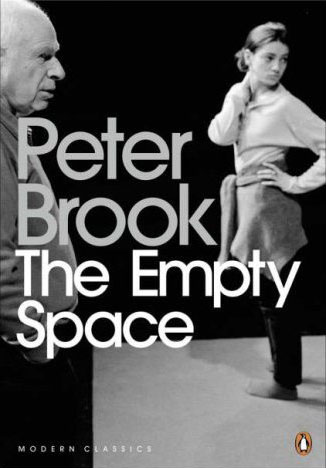
Peter Brook largely condemns the idea of 'The Deadly Theatre' or 'capitalist theatre', theatre that is dead, empty, monotonous and provides no transcendental experience. In his book 'The Empty Space', Brook explained why 'The Deadly Theatre' occurs in 7 steps:
- When all stage directions are prescribed by the writer, so there is no room for creativity
- Conventional theatre that follows the rules
- Theatre that is initiative rather than innovative
- Deadly theatre approaches performance from the perspective 'that somewhere, someone has found out and defined how the play should be done.'
- It persists because it doesn't adapt to a changing culture and the expectations of changing cultures.
- It persists because it is capitalist theatre that is more consumerist than creative.
Instead, Peter Brook was fascinated with the 'holy theatre' - a new, fresh theatre that adds to the art form. He talks about the idea that theatre can happen and occur anywhere, and wanted it to be full of endless possibility where it is always changing in response to society. He was constantly determined to 'net the golden fish' and transform our thinking, and as a result he liked to create massive visual spectacles and subversive pieces of art: for example, his version of A Midsummer Night's Dream at the RSC in Stratford in the 1960s was his breakthrough performance. It involved a white, bare set with all the actors flying around the stage on swings on various levels. Through this production, he created memorable, elaborate images through using Shakespeare's text as a basis and re-imagining it in a fantastical way.As well as this, Brook was fascinated with the idea of ritualistic theatre and wanted the experience of theatre to be almost like a ritual too. Theatre should be like a ritual in the fact that it is a communal experience, he thought, theatre can therefore cause healing and revelation. The role of theatre should be resounding affirmation in everyone's lives: people must be given a hunger for art and see that it is necessary for life.
Exercise One: Blindfolded
As actors, often we rely too much on sight to communicate within a play. In this exercise, we took the sight away through blindfolding too people within the circle and giving them the simple task to find the paper baton somewhere in the circle and hit the other person with it. As spectators in the circle, we had to be very silent so that the two participants had one less sense of hearing where they were. This exercise was very interesting to observe because as soon as the two participants were blindfolded, it was evident how imminently they became vulnerable within the space. They had to trust themselves, each other and us as an audience within the space and there was instantly a sense of ensemble feeling. As spectators we had the benefit of dramatic irony, and the pursuit of the two people in the space having to find the paper baton and then the other person was very funny and entertaining to watch, particularly when one of them would be really close to the other person who had the baton, for example. Their vulnerability and stripped down senses meant that their pursuit to carry out this task in the circle was purely instinctual and reacted based on their impulses, and when they were less concerned about how this would look and it meant that their performance within the circle was very truthful. When TJ was hit by Rrahiim with the paper baton, his reaction was so dramatically comedic and animated yet so truthful, and these moments were really interesting and funny to watch. This links to Brook's ideas because he wanted the same vulnerability that the participants possessed in this exercise to be abundant all the time, as a result creating raw, powerful and truthful reactions based on instinctual impulses. It also inhibited the idea of a conventional 'Deadly Theatre' play which often lacks the awareness of other sensory forces.
Exercise Two: Internal Emotion Reflected Through The Body
This involved a series of improvisations. The first one myself and Stash did: our task was to enter the room, face the wall, sit down and adopt a state of being almost like we were meditating. Stash entered the room first: she was incredibly neutral. I entered the room second but I was focusing on this inward emotion that I possessed: anger. The spectators were observing this as it took place, and were making observations on how myself and Stash differed just through the way we were sitting and existing within the space. As it turned out, people got the sense that in comparison to Stash, I was agitated and occupied by an emotion because I was sat a lot more upright, I was moving more and I was breathing a lot louder than Stash. In contrast, Stash was sitting very still in an incredibly neutral position. This exercise amplified the way in which our body language even through the most subtle and small gestures can alter how you exist within a space, and the way in which your audience interpreted it. We repeated this exercise similarly many times, and as an observer I concentrated on understanding the emotion that people were projecting just from sitting in front of a wall. What I gathered from this was that 'less is more' as the people that were most enticing and effective to watch were the ones who didn't try and show what they were feeling, but instead internalised it and let it affect them in this way. Eventually, sounds were also used to communicate emotion, but I'd argue it was more effective without sound as a lot of the sound quite literally represented the emotion. Overall, this exercise was very important in accentuating Peter Brook's idea of the potential power of 'The Empty Space'.
Exercise Three: Making Sounds to Communicate Orders
In pairs and without verbal communication, we tried to make unusual sounds based on our own impulses that ordered our partners to do a certain action. I found this quite challenging and I don't know if it worked between me and Stash - my order was to get her to hug me and I tried to make more emotional sounds that created associations of being sad and wanting attention, such as heavy sighs. When this didn't work, I tried to literally get her attention by clapping but then she just copied, so I don't think it was very successful. Nevertheless, this exercise was important in highlighting the importance of a connected ensemble who aren't reliant on sight and verbal speaking to communicate.
Exercise Four: Using Bamboo Sticks to Create a Ritual
 The last thing we did in the session was use bamboo sticks to almost explore the idea of ritualistic theatre that Brook is in favour of. Our primary task was in pairs to take a bamboo stick on a journey around the room using one finger each. As opposed to us carrying the stick, the focus was to make the stick embody our 'soul' and then let it guide us. We then tried to emulate an emotion through the sticks' journey: me and Stash expressed happiness, but other people expressed spirituality and curiosity as other examples. We all possessed a bamboo stick and began to acquire and develop a relationship with the bamboo stick and its details, trying to find minimum surface content and then we took that bamboo stick on a journey around the room. This culminated in group work where we made various shapes with the sticks. From this exercise, I gathered a greater sense of Brook's ideas of how theatre is a communal experience.
In pairs and without verbal communication, we tried to make unusual sounds based on our own impulses that ordered our partners to do a certain action. I found this quite challenging and I don't know if it worked between me and Stash - my order was to get her to hug me and I tried to make more emotional sounds that created associations of being sad and wanting attention, such as heavy sighs. When this didn't work, I tried to literally get her attention by clapping but then she just copied, so I don't think it was very successful. Nevertheless, this exercise was important in highlighting the importance of a connected ensemble who aren't reliant on sight and verbal speaking to communicate.
Exercise Four: Using Bamboo Sticks to Create a Ritual


No comments:
Post a Comment