ANTONIN ARTAUD AND HIS EFFECT ON THEATRE TODAY

Antonin Artaud is one of the most prominent figures in the evolution of modern theatre as an actor, dramatist, poet, actor and general theoretician of the Surrealist movement in the 1920s. He evolved the idea of the 'theatre of cruelty' and set up an experimental theatre company to embark one exploring his theories.
ARTAUD'S EARLY LIFE
Antonin Artaud was born as Antoine-Marie-Joseph Artaud on September 4th 1896 in Marseille, France, a metropolitan port town. His parents were Levantine Greek and he was affected very much by this background through his fascination of mysticism or 'religious ecstasies' In his younger years, Antonin spent a lot of time in Turkey with his mother's side who were inherently Turkish. Antonin was 'bathed in multiple languages', which influenced his later writing', as his family spoke Greek, French, Turkish and Italian. When his grandmother died, it deeply affected Artaud: his summers with her in Turkey as said by Bettina Napp were filled with a sense of 'closeness and a calness, a sense of belonging and an inner joy' which contrasted Antonin's unhappy tense home life. Moreover, Antonin's childhood was filled with more grief as out of the 8 children that his mother had, only three survived into adulthood. He had also survived a very near death experience in Turkey as he had nearly drowned one summer, and had also had a severe attack caused by meningitis when he was only five. This deep suffering was to become recurrent throughout Artaud's life.
He was only a young man when World War One broke out in 1914, and was conscripted into the army initially spending nine months training in Digne. Nevertheless, he was soon discharged due to his evident depression. Artaud had a history of chronic mental disorder, and as a result he was hospitalised into a mental institute when he was only nineteen for depression. There, he read Arthur Rimbaud, Charles Baudelaire and Edgar Allan Poe. As a result, at age 21 Artaud was prescribed a liquid form of heroin/opium as 'laudanum', which led to life long addiction. He moved closer to Paris so that he could pursue involvement in the arts.
ARTAUD IN PARIS
In March 1921, Artaud embarked on his journey as an actor and into the world of Surrealism, which subverted his father's wishes. He wrote poetry and essays and trained with directors such as Charles Dullin and Georges Pitoeff simultaneously. At age 27, his own Surrealist poetry such as L'ombilic des limbes of 1925 and Le Pèse-nerfs of 1925 were rejected by La Nouvelle Revue Françajse but then were sent to Jacques Rivière, an influential critic and editor of the journal who became associated with him from that point. This progressed into Artaud's first epistolary work called Correspondance avec Jacques Rivière.
Artaud was interested in cinema and wrote the scenario for the first surrealist film of 1927, The Seashell and the Clergyman which was directed by Germaine Dulac. This film became prominent in inspiring two Spanish surrealists, Salvador Dali and Luis Bunuel.
He studied as an actor in Paris and then made his debut at the Dadaist-Surrealist Théâtre de l'Oeuvre founded by Aurélien Lugné-Poë. Despite this, he was soon rejected by the Surrealists as he was seen as 'too individual' and had disagreed politically with the deference of the Surrealist leader André Breton to communism. In fact, Artaud wasn't into politicsat all and hated any kind of ideology - he was an anarchist. Breton also didn't like Artaud's resentment towards the theatrical landscape at his time and despised how he tried to fund his own various theatrical projects, seeing it as 'too bourgeois'. This culminated in Artaud's ultimate rejection by the Surrealists, a common occurrence under the authoritative leader Breton.
He then joined another defecting Surrealist, Roger Vitrac and started a theatre company called Alfred Jarry along with Vitrac and Robert Aron, which was sadly short lived from 1926-1928 yet they aimed to create a forum for works that could radically change the French theatrical landscape. Artaud was particularly appalled at the way in which Western theatre had become lazy in how it affected and challenged audiences. As a result, he produced and directed works that Vitrac had written, and also became interested in the works of Claudel and Strindberg. Despite the theatre being short lived, it was attended by various European artists and developed significant popularity in its time.
"I myself am an abyss" -Antonin Artaud
'THE THEATRE OF CRUELTY': 1938
 Artaud recorded his ideas and criticisms of modern theatre through works like 'Le theatre de la cruaute' and 'The Theater and Its Double, which were published as manifestos in 1938. The theatre of cruelty advocated a type of theatrical experience unbeknown to the time, combining elaborate props, magic tricks, lighting, gestures and articulations with vivid dark themes to provoke an intense experience for the audience in coming to terms with the base elements of life and creating a 'communion between actor and audience in a magic exorcism'. He thought that a lot of Western theatre wasn't effective in challenging the audience in this way, and wrote about themes such as rape in works like 'Les Cenci', a play about a man who rapes his daughter. Although it eventually did become produced in Paris in 1935, it received a lot of backlash and was discontinued after only seventeen performances. 'The Fountain of Blood' was another prominent work that discussed the creation of the world and its subsequent destruction by humans, mostly women. Artaud strived to bring out the natural and ugly instincts that were suppressed by the human facade, and wanted these to be exposed through his plays. 'Les Cenci' and 'The Fountain of Blood' both challenged conventional norms. This became known as the 'theatre of cruelty' simply for its cruelty: Artaud believed that this cruelty was needed to essentially wake the audience up and get them to embrace the cruelty of human existence through a violent and physical determination. He was particularly inspired by Eastern forms of theatre, particularly Balinese dance as the ritualised physicality and rhythms advocated the idea of a theatre of cruelty.
The Theatre of Cruelty re-defined the limits to which an audience could be pushed, and the horrors that they could experience. Artaud's brand of surrealism aspired to strip the illusion of theatrical falseness, and instead he wanted to instigate and provoke reality from theatre itself. He wanted to delve into the inner workings of human nature to ultimately disturb the audience.

Artaud's theatre of cruelty was never really accepted or embraced in this lifetime but today his ideas still have much significance and his concepts are studied and analysed by many authors and writers.
Taken from the Poetry Foundation, Author George E. Wellwarth explained that the theatre of cruelty is 'the impersonable, mindless and therefore implacable cruelty to which men are subject. The universe with its violent natural forces was cruel in Artaud's eyes, and this cruelty, eh felt, was the one single most important fact of which man must be aware... Artaud's theater must be ecstatic. It must crush and hypnotise the onlooker's sense."
The Theatre of Cruelty is still significant today, it allows pre-existing texts to be revived and to be delivered in a much more challenging way through Artaudian techniques.
“Theater of Cruelty means a theater difficult and cruel for myself first of all. And, on the level of performance, it is not the cruelty we can exercise upon each other by hacking at each other’s bodies, carving up our personal anatomies, or, like Assyrian emperors, sending parcels of human ears, noses, or neatly detached nostrils through the mail, but the much more terrible and necessary cruelty which things can exercise against us. We are not free. And the sky can still fall on our heads. And the theater has been created to teach us that first of all.” -Antonin Artaud
After Alfred Jarry was a failure, in 1936 Artaud travelled to Mexico and met his first Mexican-Parisian friend Federico Cantú, who lectured on the decadence of Western civilisation. He studied and lived with the taruhumaran people and learnt their various rituals - his experiences were later published in a volume called 'Voyage to the Land of the Tarahumara'. The content of his work recording these experiences correlates with his later poetry which is dominated around the idea of the supernatural. In Mexico also, Artaud experienced horrific withdrawal symptoms from heroin. This was the beginning of a number of episodes: significantly, in 1937, Artaud returned to France and soon travelled to Ireland in an attempt to return a walking stick he owned to Jesus Christ, who he thought was the rightful owner. This culminated when he was forcibly removed from the grounds of Milltown house and had refused to leave, and then was deported after being kept in Mountjoy prison. The Irish government papers branded him as a 'destitute and undesirable alien'. Furthermore, Artaud was arrested when he attacked two crew members on the ship back to France, believing that they were attacking him first.
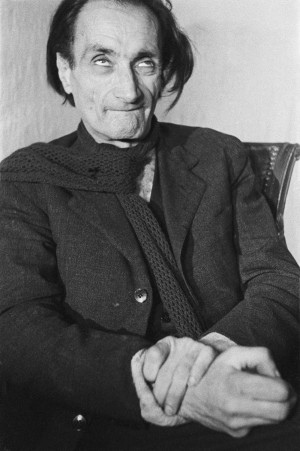
After Artaud returned from Ireland, he began to deteriotate and spent the majority of the rest of his life in various asylums. He was penniless, and had been put into a psychiatric hospital in the 1940s where he was administrated electroshock treatment. Although this was controversial at the time, this hiatus led to his release in 1946 when Artaud began to write again. He was encouraged very much to write again during this hiatus, and these writings were published in the journal 'Demain'. His work increasingly reflected his mental afflictions. Artaud became obsessed with the human body, but loathed sex and wanted to separate himself from his sexuality, he also denounced the Church but otherwise would defy himself by pronouncing faith in God. Nevertheless, during this time, he wrote some of his best poetry in the final three years of his life.
In January 1948, Artaud was diagnosed with colorectal cancer and died soon after on the 4th of March alone in a psychiatric clinic, although it is unknown whether he took his own life or not.
ARTAUDIAN TECHNIQUES / CONCEPTS
1) Visual Poetry
Artaud accentuated the importance of gesture, dance and movement over the use of words. This was almost the first notion of physical theatre before it was a recognised genre. He hailed the use of soundscapes, sound effects, music and nonsensical language (even inventing his own language at a point) as long as it created emotional impact. Emotional impact was seen as a greater priority in contrast to telling a story.
2) Creating a 'Dream-World'
Artaud wanted to encapsulate a dream world in his work. He wanted the grotesque, dark and base instincts represented in nightmares and dreams to be potent in his work. In contrast, it could be argued that naturalistic plays would represent a more realistic sense of reality, which he thought was a suppressed illusion. As a result, Artaud wanted to implement anything that would turn reality on its head such as; rituals (as he thought they were outward symbols for inner meaning), masks, striking costumes and colour, costumes and lights.
3) 'Assaulting' the Audience
Through his 'theatre of cruelty' Artaud accentuated the idea of shocking the audience and forcing them to come to terms with the dark and inherent elements of human nature. He criticised Western theatre heavily, believing that its 'picture-frame' esque fourth wall stage inhibited any sense of reality, and instigated an illusion. He wanted to make theatre that was visceral, gutsy and shocking, making audiences feel deep and intense emotions such as fear so that they could confront the reality of their own lives. He did this through intensely breaking the fourth wall, with aspirations to eventually put audiences on swivelled wheeled chairs that could give the audience a part in the midst of the action. With this, to truly assault the audience, Artaud exaggerated the importance of highly skilled actors who were emotionally raw, and wanted to push them to their extremes as well as the audience.
"The theatre of cruelty will choose themes and subjects corresponding to the agitation and unrest of our times" -Artaud


