JERZY GROTOWSKI AND HIS EFFECT ON THE THEATRICAL LANDSCAPE

Jerzy Grotowski was born in 1933 in the city of Rzeszów in south east Poland, and since then has become known as one of the grearest reformers of 20th century theatre. He was a theatre director, theoretician, educator and creator of acting methods.
GROTOWSKI'S EARLY LIFE AND CAREER
Grotowski was born on the 11th of August 1933 in Poland. The war came in 1939 soon after and the strong familial bond Grotowski held was destroyed, with his father conscripting and never returning. Grotowski as a result grew up with the destruction and horrors of the Second World War pervaded around him. As a result, he moved to the small village of Nienadówka where Grotowski experienced a lot of essential things that shaped him and his work in the future.
In 1951, Grotowski began studying at the National Theatrical Academy in Kraków and graduated from the State Higher School of Theatre with a degree of acting. In 1955-1956, he began to study directing at the Lunacharsky Institute of Theatre Arts in Moscow. There, he learnt about the concepts of Russian theatre symbols such as Stanislavski, Vakhtangov, Meyerhold and Tairov. He has been said to admire Stanislavski as 'the first great creator of a method of acting in the theatre', someone he believed had asked 'all the relevant questions that could be asked about theatrical technique'.
In 1957, Grotowski made his debut as a director at the Stary Theatre in Kraków where he collaborated with Aleksandra Mianowska on a production of The Chairs. At this time, he was also prominent in creating polish radio plays, based primarily on Chinese and Tibetian legends as well as Indian theatre. He was avidly interested in Asian philosophy, and optimised this through discussion at the student club Pod Jaszczurami meaning 'under the sign of the lizards'.
In 1959, Grotowski joined a newly founded theatre called the Laboratory Theatre, which permanently appeared in western Europe in 1966. The first production at this new theatre in Opole premiered in the same year as Jean Cocteau's Orpheus. One year later, Grotowski was involved in directing George Byron's Cain. As a result, he became acquainted with Jerzy Gurawski, an architect and they collaborated in the latter production of Cain, leading to a new organisation of theatrical space which culminated in the abolishment of a 'picture frame stage' and the division between the audience and the actor. In 1961, as part of the 'Public Stage' of the Teatr 13 Rzędów the director put together two productions that were so-called fact-montages: Turyści (Tourists) and Gliniane Gołębie (Clay Pigeons) were based on authentic documents, documentary film footage, and archival sound recordings.
Grotowski loved to look at existing texts, and was interesting in reviving them through his theories and conceptual visions. Before the Laboratory Theatre or 'Teatr Laboratorium 13 Rzędów' closing in 1965, he directed a series of productions including an adaption of Faust by Christopher Marlowe, 'The Tragic Fate of Doctor Faust' in 1963, A Study of Hamlet, adapted from Hamlet by William Shakespeare as well as a third variation of Acropolis by Stanisław Wysipiański in 1964.
 When the theatre closed in Opole, Jerzy Grotowski relocated his ensemble to Wrocław, reviving its adaptation of Acropolis in collaboration with Józef Szajna. This new theatre based in Wrocław was referred to the 'Instytut Badania Metody Aktorskiej' by Grotowski, or 'The Institute for the Srudy of Acting Methods'. Grotowski's break through production at this new and continued theatre was a play called Apolcypis Cum Figuris, which embodied a Christian stance through drawing on quotes from the Bible, the works of Fyodor Dostoyevsky, Thomas S.Eliot and Simon Weil. Along with 'The Constant Prince', the premiered play of the time of the theatre's opening, and Akropolis, this play became one of the most famous of Grotowski's productions throughout the world, recognise din three different versions of 1968, 1971 and 1973. In 1971, the Wrocław theatre eventually acquired new name: 'The Actor's Institute - Laboratory Theatre'. His subsequent productions were then created with his leading actor, Ryszard Cieślak. In the 1960s and the 1970s, the Laboratory Theatre went on many grand foreign tours and participated in the majority of the world's most significant theatre festivals.
In one of his first productions, Grotowski did an adaptation of 'Gods of Rain', a literary novel written by Bogowie deszczu, however it optimised controversy as Grotowski had 'collided with the author, while his theatre collided with literature'. Grotowski had changed the title of the play and interlaced the text with fragments from poetry and film. In the programme to the production, Grotowski detested by saying that "to select an author's play, does not mean to share his views". In an interview later, he expanded on this by saying that "in terms of my attitude to the dramatic text, I think that the director should treat it solely as a theme upon which he builds a new work of art that is the theatrical spectacle". From this moment, he became very defensive as a director that liked to work with text, making most productions built 'according to' or 'baed on the words of' the text's author. He wanted to transform plays completely into theatrical impressive spectacles. Arguably, some people thought he was too experimental as he tried to literally 'edit productions' like a filmmaker might edit a film. He later admitted that Cain was 'more of an exorcism of conventional theatre than a proposal for a counter-program'.
 As a result, Grotowski at this time was beginning to significantly create his own 'program'. He wanted to research deeply into the relationship between the stage and the audience and therefore the actor-audience relationship. For example, in Sakuntala the audience became the role of the collective hero, in Forefather's Eve they were immersed as participants in the ritual and in Kordian they were the patients of a psychiatric ward. Grotowski focused in new and exciting ways for actors to express themselves on stage, particularly through the exploration of 'Shakuntala', which Grotowski later stated that they had used to test 'the possibilities for creating signs within the European theatre. Our intentions were not entirely deprived of mischievousness: we sought to create a production that would be an image of Oriental theatre, not entirely authentic, but similar to the manner in which Europeans would imagine it. However, below the surface of this search that was at once derisive and directed against the viewer, there was a hidden program - the effort to discover and reveal a system of signs that would be appropriate to our theatre and appropriate to our civilisation". Through this process, Grotowski discovered a set pattern and began 'the initiation into a search in the realm of organic human reactions, and to the creation of a structure of these reactions. This is what resulted from this most fruitful adventure in our troupe's history, specifically, it resulted in our research into the art of acting'.
THE 'POOR' THEATRE / 'TOWARDS A POOR THEATRE'
In 1965, in an issue of the monthly Odra, Grotowski published a sketch titled Ku teatrowi ubogiemu (Towards a Poor Theatre) which later became the title of his book published in Denmark in 1968, and later in the United States (with a preface by Peter Brook). It became significant as a book studied in many countries, very important as a book for exploratory and experimental theatres in the 60s/70s.
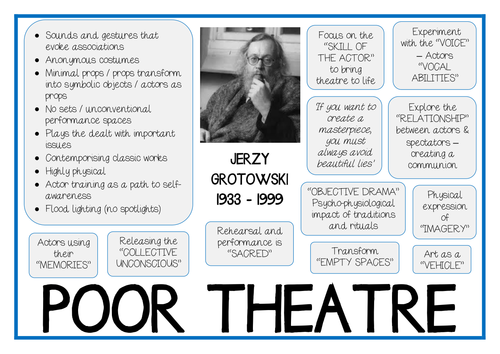 The book was an encapsulation of how Grotowski developed as a director in his primary creative period where he focused on specific acting methods and formulating the idea of a 'poor theatre'. A 'poor theatre' subverted from technological resources used in 'rich theatre' and any other theatrical trappings: he wanted the actor's voice and body to be central to the work, with minimal lighting, costume and sets. The book illustrated on how physical work by actors that took place for long periods of times and was largely inspired on East Asian techniques, with a big emphasis on the voice resonators. He was enthuasiastic about tapping into the sources of ancient expression, and was also interested in Carl Jung, a psychiatrist and as a result sought out archetypes to ensure that roles could be built authentically, with the actors committing to it almost like an act of sacrifice. These acting techniques were not intended to be like a state of trance, but were committed to nurturing precise acting in a state of sharpened consciousness.
The Constant Prince and Apocalypsis Cum Figuris were demonstrations of the emergence of ecstatic acting, and exemplified the concept of 'poor theatre'.
Here is an extract from 'The Empty Space' written by Peter Brook, who was influenced by Grotowski greatly and talked about the 'poor theatre':
In Poland there is a small company lead by a visionary, Jerzy Grotowski, that also has a sacred aim. The theatre, he believes, cannot be an end in itself; like dancing or music in certain dervish orders, the theatre is a vehicle, a means for self-study, a means for self-study, self-exploration, a possibility of salvation. The actor has himself as his field of work. [...] Seen this way, acting is a life's work - the actor is step-by-step extending his knowledge of himself through the painful, ever-changing circumstances of rehearsal and the tremendous punctuation points of performance. In Grotowski's terminology, the actor allows a role to 'penetrate' him; at first he is all obstacle to it, but by constant work he acquires technical mastery over his physical and psychic means by which he can allow the barriers to drop. 'Auto-penetration' by the role is related to exposure: the actor does not hesitate to show himself exactly as he is, for he realizes that the secret of the role demands his opening himself up, disclosing his own secrets. So that the act of performance is an act of sacrifice, of sacrificing what most men prefer to hide - this sacrifice is his gift to the spectator. [...] Grotowski makes poverty an ideal; his actors have given up everything except their own bodies; they have the human instrument and limitless time - no wonder they feel the richest theatre in the world. - Peter BrookIn the 1970s, Grotowski became sidetracked from the prospect of theatre and didn't produce any theatrical productions, instead becoming more obsessed with Central Asian culture and spirituality. In 1970, he travelled to India to venture on this interest. He also became more involved in teaching classes for Polish and foreign actors - through this, he wanted to focus on interpersonal relationships between actors and the interactions between human beings in general. Although he had previously focused on banishing the division between audience and actors, in 1973 this became almost abolished through a new way of creating theatre that completely abolished any boundaries between actor and audience completely. He invited participants from around the world to become involved in group séances that had an ethical and psychotherapeutic dimension to them, to find some sort of inter-personal understanding between communal action, whether that would be involving voice, movement or group singing.
THE THEATRE OF THE SOURCE
In 1976, Grotowski became mainly focused on the idea of 'Teatr Zródeł' or 'Theatre of the Source' which he prusued in the northern city of Białystok, as well as voyages to Mexico, Nigeria, India and Haiti. This was highly focused on the idea of anthropology and looked at rituals from around the world, finding the common denominator between them which encapsulated a theatrical form. Techniques were applied to create a tangible link and connection with the natural world.
OBJECTIVE DRAMA
"Art is a ripening, an evolution, an uplifting which enables us to emerge from darkness into a blaze of light" -Jerzy Grotoski


No comments:
Post a Comment