In our session, we had to respond to a number of stimuli created by three artists/playwrights, including Sarah Kane and Tim Etchells through drawing on a piece of paper:

This is what I produced. Essentially, it's just a lot of scribbles on paper consisting of lots of jagged and rough lines but considering a lot of the stimuli material was dark, these were the most direct associations that immediately came to mind. Through a discussion on our exploration through drawing and art, it became apparent that really dark, vivid and sensitive themes that are often suppressed everyday by society are most poignant in these art forms, highlighting the power of art and theatre in addressing what is usually suppressed by humans, and as Artaud said portraying through the 'Theatre of Cruelty'.
SARAH KANE
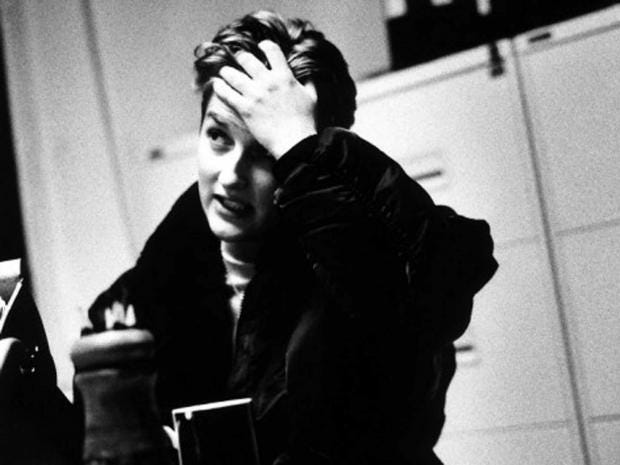
In particular, through this exercise I became quite fascinated with Sarah Kane as an artist.
Sarah Kane was an experimental playwright and poet originally from Essex in England. Her work is experimental because it consists of themes of sexual desire, pain, torture, depression, redemptive love and death. Her work is intense and bold, using extreme and violent stage action and using pared down language. She was heavily inspired by expressionist theatre and Jacobean tragedy, and has also been associated with In-Yer-Face theatre.
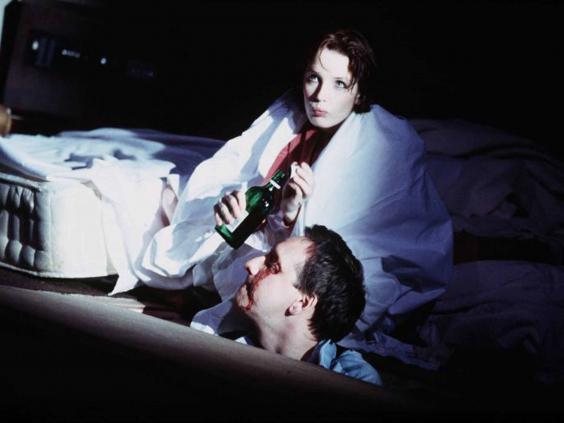
Her first play was 'Blasted' published in January 1995 which received extreme press criticism. The story takes place in a Leeds hotel room where an older male journalist is attempting to seduce a young woman with raw language and tackling powerful images of rape and cannibalism. On the front page news of the Daily Mail and by even well respected critics, it was branded 'filth', the Sunday Telegraph called it 'canrage' and the Spectator called it 'a travesty of a play'. Blasted didn't just shock because of its explicit sexual and violent themes, but its innovative structure in which the first half encompassed naturalism and the second half encompassed an almost nightmarish unstructured and symbolic premise.
Subsequently, Kane's future works included Phaedra's Love, Cleansed and Crave which developed on an incentive to portray extreme emotional content and theatrical innovation. Sarah Kane remained equally as controversial as she had done with Blasted, but continued to make theatrical innovations, for example with Crave she had four nameless characters who didn't have direct conversations yet had set dialogue which could be addressed at anyone on stage.
4.48 Psychosis was Sarah Kane's last play shortly before she committed suicide at age 28, and tackles suicidal depression. Many argue that this play wasn't an artistic visionary work but was more a reflection of her direct life and emotions, simply reproducing her mental illness, whereas others emphasis Kane's talent for continual theatrical technique.
 Putting visceral and raw themes on stage almost engages with Artaud's idea of embracing the Theatre of Cruelty, and as we are devising a piece for experimental, research into Sarah Kane has really informed my awareness of how far the boundaries can be pushed through theatre between the audience's comfort and the actors conveying these themes.
INDIVIDUAL GROUP DEVISING
Throughout the devising process, we have focused pre-dominantly on devising a piece in groups associated with dreams and based on a stimulus and then performing them to the rest of the group for contribution to the final piece.
I was working with Liv, Stash, Rrahim, Martha and Tallulah in creating a piece inspired by Tim Etchells' 'The Dream Dictionary for the Modern Dreamer'. Throughout our devising process, we continually related our work and inspiration back to our associations with dreams and the city of dreams.
We eventually produced a piece that explored how the true playful human nature inherent in all of us comes out in our dreams and through our imagination, and how over time the structures and restrictions that society has implemented have often regulated our imagination to a point where in our dreams we rebel against this and vivid dreams with nonsensical playful aspects are poignant. This idea was evoked by discussion as a group, as well as improvisation which is quite integral to devising experimental theatre. Furthermore, we produced this through using the text from Tim Etchells' Dream Dictionary to portray assets of the 21st Century and how they may be conveyed through dreams, and through doing a number of spontaneous exercises acting on impulse and tapping into the inner playful 'hooligan nature' of us all we produced a 5 minute piece. At the end of our piece we involved audience participation by improvising a song that provokes the audience via the Theatre of Cruelty with lines such as 'You are dying'... 'Your time's running out' and then 'This is all a dream' to the popular tune of 'We Will Rock You' to again integrate the ideas of modernity and its hold on us as a society. In the first week of devising, it was received generally well by the audience and it definitely as a new and fresh devised work held a lot more spontaneity and therefore was appraised more enthusiastically by us as a group.
Nevertheless, embarking on improving, refining and rehearsing the devised piece a couple of weeks later through integrating more text into Etchells threw up a challenge in the process that we hadn't experienced two weeks before. I think that naturally over time the enthusiasm that came with a freshly produced piece developed off fresh conversation, imagination and ideas had lost some of what made us all excited about it to the point that when we rehearsed it again, we immediately didn't believe in the credibility of it as an artistic work. Also, I think that in the first week of devising, our link Etchells' work as a stimulus was quite loose so adding more text immediately became more challenging: we cut quite a lot of the material that didn't encompass anything that evocative, and this included the song. Originally the song was effective because again we were all committed towards the pursuit that it was a original idea, yet as many of the other groups had produced songs too we decided to cut it as weren't as committed to it as something that would actively improve and give the piece more colour and dimension. What had originally been a direct reading of Etchells' work evolved into a more spontaneous improvisation based off our thoughts and feelings on ideas explored in the Dream Dictionary in the final work, and I think this was a solution to the lack of inspiration we had felt having to integrate more text into the piece, when originally our enthusiasm of the piece was based off the ideas we were gaining off insights into the Dream Dictionary itself.
In correlation with our ideas into the whole group piece as a whole, we made a decision to play electronic music with the piece which corresponded with Artaud's idea of having 'ear shattering sounds' as part of the work. Using the song 'Four Years and One Day' by Mount Kimbie, it helped us feed off the upbeat rhythm it has throughout adding to the spontaneous energy of the mostly improvised element of our devised piece.
TIM ETCHELLS

We eventually produced a piece that explored how the true playful human nature inherent in all of us comes out in our dreams and through our imagination, and how over time the structures and restrictions that society has implemented have often regulated our imagination to a point where in our dreams we rebel against this and vivid dreams with nonsensical playful aspects are poignant. This idea was evoked by discussion as a group, as well as improvisation which is quite integral to devising experimental theatre. Furthermore, we produced this through using the text from Tim Etchells' Dream Dictionary to portray assets of the 21st Century and how they may be conveyed through dreams, and through doing a number of spontaneous exercises acting on impulse and tapping into the inner playful 'hooligan nature' of us all we produced a 5 minute piece. At the end of our piece we involved audience participation by improvising a song that provokes the audience via the Theatre of Cruelty with lines such as 'You are dying'... 'Your time's running out' and then 'This is all a dream' to the popular tune of 'We Will Rock You' to again integrate the ideas of modernity and its hold on us as a society. In the first week of devising, it was received generally well by the audience and it definitely as a new and fresh devised work held a lot more spontaneity and therefore was appraised more enthusiastically by us as a group.
Nevertheless, embarking on improving, refining and rehearsing the devised piece a couple of weeks later through integrating more text into Etchells threw up a challenge in the process that we hadn't experienced two weeks before. I think that naturally over time the enthusiasm that came with a freshly produced piece developed off fresh conversation, imagination and ideas had lost some of what made us all excited about it to the point that when we rehearsed it again, we immediately didn't believe in the credibility of it as an artistic work. Also, I think that in the first week of devising, our link Etchells' work as a stimulus was quite loose so adding more text immediately became more challenging: we cut quite a lot of the material that didn't encompass anything that evocative, and this included the song. Originally the song was effective because again we were all committed towards the pursuit that it was a original idea, yet as many of the other groups had produced songs too we decided to cut it as weren't as committed to it as something that would actively improve and give the piece more colour and dimension. What had originally been a direct reading of Etchells' work evolved into a more spontaneous improvisation based off our thoughts and feelings on ideas explored in the Dream Dictionary in the final work, and I think this was a solution to the lack of inspiration we had felt having to integrate more text into the piece, when originally our enthusiasm of the piece was based off the ideas we were gaining off insights into the Dream Dictionary itself.
In correlation with our ideas into the whole group piece as a whole, we made a decision to play electronic music with the piece which corresponded with Artaud's idea of having 'ear shattering sounds' as part of the work. Using the song 'Four Years and One Day' by Mount Kimbie, it helped us feed off the upbeat rhythm it has throughout adding to the spontaneous energy of the mostly improvised element of our devised piece.
TIM ETCHELLS
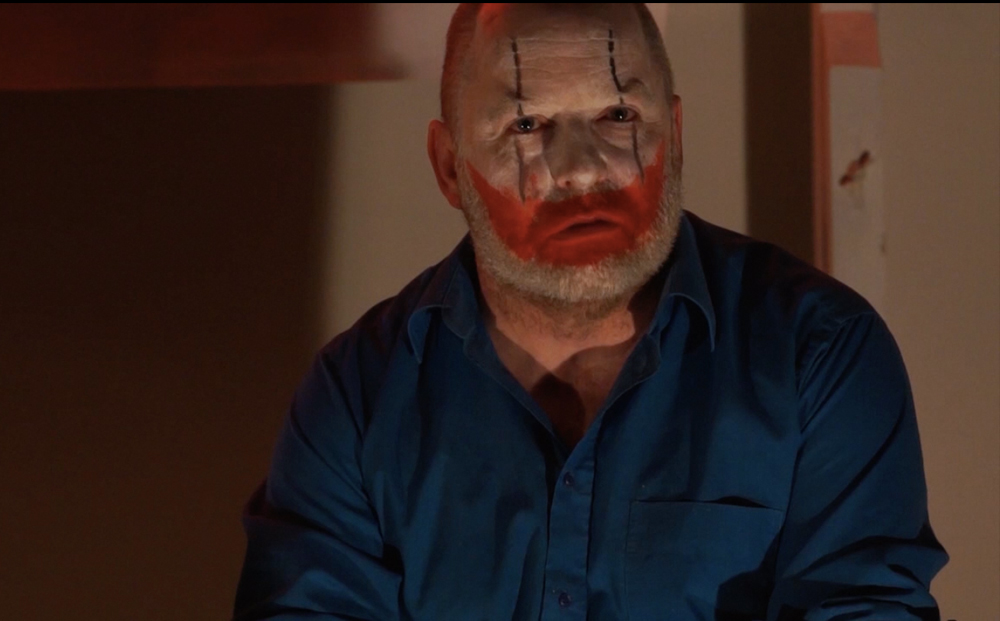
Tim Etchells is a British artist and writer who is based in Sheffield and London. He has his own theatre company called Forced Entertainment which is an experimental theatre company in which he is the artistic director. He has published a number of fictional works, including Endland Stories, The Dream Dictionary for the Modern Dreamer (stimulus) and the novel The Broken World.
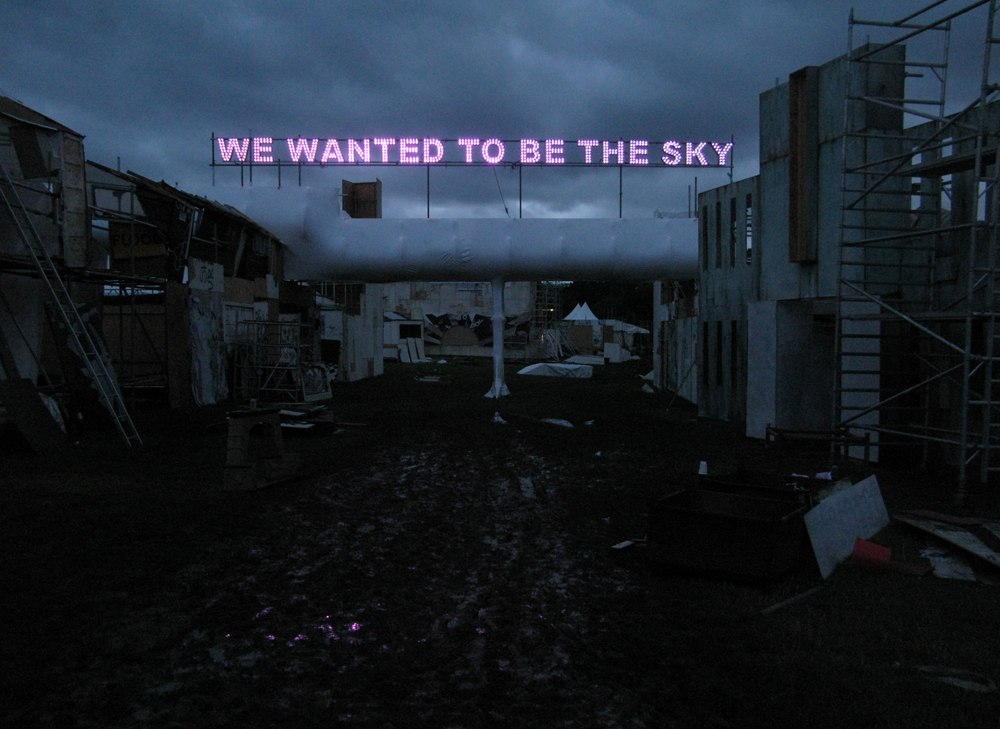
He frequently collaborates with artists, and makes public sculpture works such as A Stitch In Time which was commissioned for the Lumiere Festival and comprised of signs made of LED bulbs. Other exhibitions he has worked on include 1999 Void Spaces and the ongoing series Empty Stages.
An Art in America article on 'Happy Days in the Art World' commented on Etchells: 'Etchells is an experimental British playwright of some fame whose work is Beckettian, not Beckett-esque. His work is mocking and meandering but can really get under the skin, and prick at latent feelings of abjection, loneliness, the inability to communicate, futility'.
It was this essence of the research I did into Etchells as well as his other work that has made me really inspired by him as an artist. In terms of our vision for our eventual piece about the 'dream city', Etchells is a very relevant stimulus because his work (particularly in a lot of the images I've listed below) integrates the landscape of the city and everyday life and deeper complex emotional statements.

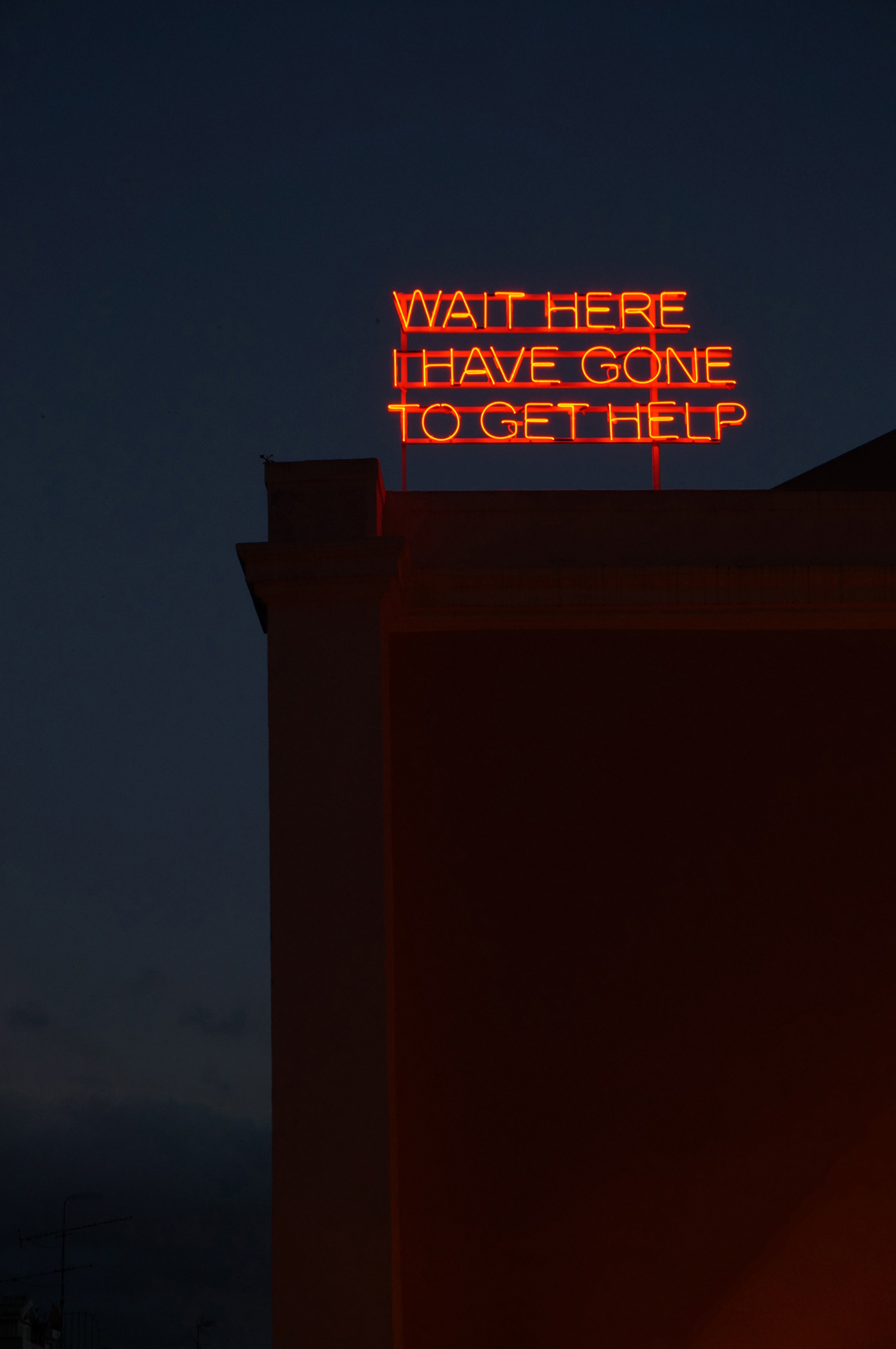


IDEAS FOR RITUALS IN THE CITY
As part of our piece, we want to represent the rituals of the city through a dream context. From my own personal brainstorming as well as group discussion, here are some of my findings and observations of some 'city rituals':
- Queuing/waiting in public spaces
- Saying sorry constantly (in correlation with the above statement) - very British sentiment
- Public transport and not talking
- Keeping to yourself
- Crowds
- Democracy/freedom of thought and the process of expressing your opinion
- Integration
- Communication
- Transportation
DREAM TEXT
I will use the first dream in my dream diary to use as a story to tell the audience. Having discussed this in class, we want to remove all traces of Western culture and ambiguise them so that the dreams seem more nonsensical, which I think in correlation with the few dreams included in my dream diary is
IDEAS FOR SHOW
"What speech the dead couldn't say whilst living, they can tell you when they're dead"
I will use the first dream in my dream diary to use as a story to tell the audience. Having discussed this in class, we want to remove all traces of Western culture and ambiguise them so that the dreams seem more nonsensical, which I think in correlation with the few dreams included in my dream diary is
IDEAS FOR SHOW
- The power of the empty space and potential of group improvisation
- Sleep ritual - putting the audience to sleep
- Ritualistic clothing: whites, blacks, greys
- Use of lighting and technology
OTHER EXPERIMENTAL ARTISTS
These are some other experimental artists that have informed and inspired me in the devising process:

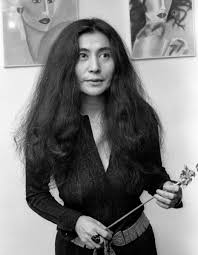
These are some other experimental artists that have informed and inspired me in the devising process:
- Björk
- Brian Eno
- Yoko Ono


No comments:
Post a Comment